Responding to PM De Wever's concerns
Responding to Prime Minister De Wever's concerns about using frozen Russian assets for Ukraine
The Choice Belgium Faces
Continued Russian Aggression
Russian drones over Doel nuclear plant and Belgian airports
Tax money loss
€140 Billion Solution that could support defense against Russian aggression
Prime Minister De Wever says using frozen Russian assets is 'too risky.' But Belgium is already paying the price of inaction. Every day of delay costs more.
The Uncomfortable Truth De Wever Won't Address
Belgium Is Already Under Attack - RIGHT NOW
Since October 2024, Russian drones, hacker attacks have disrupted:
Operations halted
Royal Military School
Europe's 2nd largest port
Five drones spotted
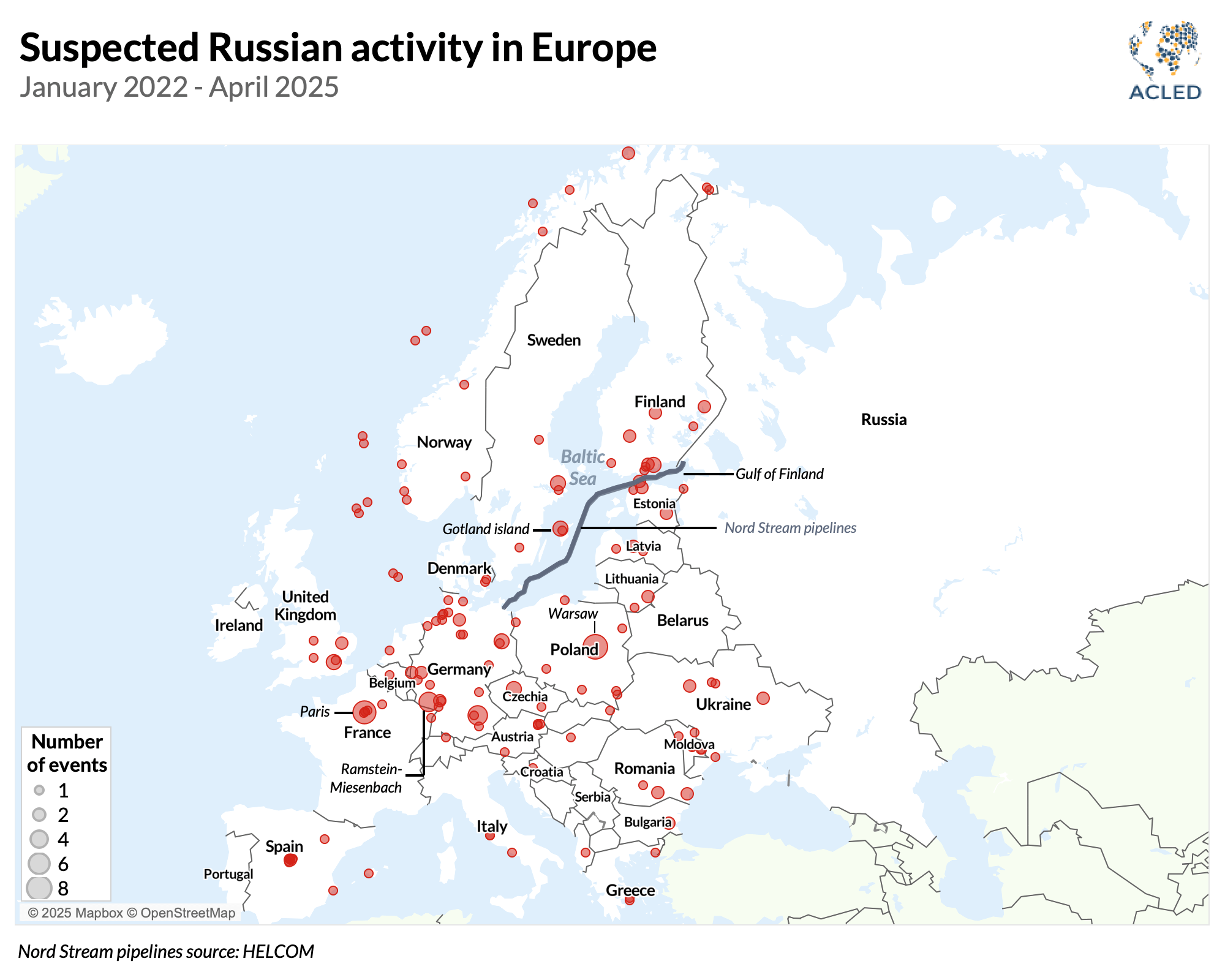
💰 Cost: €2+ million per airport incident (direct costs only)
The Pattern Across Europe:
Do we fear theoretical litigation more than the documented cost of Russian aggression happening now?
De Wever's Impossible Logic
He Blocks Every Solution While Claiming to Support Ukraine
| What He Says | The Evidence |
|---|---|
| ✓ "Ukraine needs urgent funding - before end of year" | TRUE - €135bn gap for 2026-2027 |
| ✗ "Russian assets too risky to use" | BUT ignores how Euroclear already compensated investors from the assets |
| ✗ "Coalition should fund it directly instead" | BUT admits: "Phone calls received: zero. Actually zero." |
| ✗ "EU debt better alternative" | BUT expects all EU countries to tax citizens harder |
| ✓ "I'm ready, willing, able to do whatever it takes" | SO... WHAT EXACTLY? |
The Logical Trap:
If Ukraine truly needs urgent funding (✓) AND all alternatives are blocked (✗✗✗), THEN being "ready, willing, able" requires accepting the only viable option: the Reparations Loan.
These positions cannot all be true. De Wever is blocking all solutions while claiming to seek one.
"Number of phone calls I got since proposing [coalition funding]: tends to zero. It actually is zero." - Bart De Wever
De Wever's Three "Problems" - Already Solved
Every Concern Has an Answer He's Ignoring
❓ Problem 1: "Is this even legal?"
De Wever claims: "Nobody has done this before - we're in uncharted waters"
The Reality:
- ✓ Legal framework exists: ARSIWA (Articles on State Responsibility) - countermeasures are lawful when aggressor violates international law
- ✓ Historical precedents: Iraq-Kuwait ($50bn), Iran, Argentina, Yugoslavia, Libya, Germany, Japan, Italy
- ✓ Belgium itself used such a mechanism: Received war reparations after WWI and WWII
- ✓ It's not even confiscation: Reparations Loan uses assets in a substitution/swap mechanism, not seizes them
🔒 Problem 2: "Guarantees - cash must be available immediately"
De Wever claims: "If Russia wins a claim, money must return instantly or markets panic"
The Reality:
- ✓ ECB President Lagarde said "CAN be done" with conditions (not "cannot be done")
- ✓ Loan structure preserves assets: They're used in a substitution/swap mechanism, not spent
- ✓ Russia claiming return takes YEARS: Requires (1) ending aggression, (2) winning arbitration, or (3) favorable peace treaty
- ✓ Guarantee mechanisms exist: Phased, conditional, insured structures
⚖️ Problem 3: "Risks left with Belgium"
De Wever claims: "Taking Putin's money and leaving risks with us"
The Reality:
- ✓ Investment tribunal victory extremely unlikely: CBR chances "extremely low" per legal analysis
- ✓ EU already blocks enforcement: 15th sanctions package prohibits recognition of arbitral awards
- ✓ EU took GREATER risks for LESS: Used Russian private assets to compensate investors (higher legal risk) - Ukraine's survival warrants equal tolerance
- ✓ Multi-country participation exists: G7 already using windfall profits; UK willing to seize russian assets to send to Ukraine; burden-sharing mechanisms available
The Bottom Line: De Wever presents "problems" while ignoring that solutions exist. The question isn't whether answers exist - they do. The question is whether Belgium will lead or obstruct.
What Belgium Refuses to See
The EU Already Did This for Private Investors - Why Not for Ukraine?
What Happened in December 2024 & July 2025:
Belgium, Euroclear, and the EU took much greater legal risks to protect European investors:
| Action | What They Did | Legal Risk Level |
|---|---|---|
| Apr 2025 | Used cash from Russian National Securities Depository to compensate European investors | HIGHER RISK |
| July 2025 | Blocked enforcement of arbitral awards related to such actions | Novel legal territory |
Why Private Investor Action Was RISKIER:
- Russian individuals/companies can invoke human rights protection (CBR cannot - it's 100% governmental)
- Connection to aggression less obvious than Central Bank's direct role
- Created precedent for using Russian assets anyway
Private European Investors
HIGHER legal risk
✓ EU acted decisively
Ukraine's Survival
LOWER legal risk
✗ Belgium blocks it
The Question for Belgium:
If the EU can accept greater legal uncertainty to protect private investors' portfolios, why can't it accept lesser risk to ensure Ukraine's survival and Europe's security?
This isn't about legal risk. Belgium already demonstrated it can manage legal risk when it wants to. This is about political will.
📚 The Details Behind the Arguments
The first 5 slides present the core case. What follows provides deeper technical support, additional context, and responds to secondary arguments.
Deep Dive: The Legal Framework
ARSIWA and the Doctrine of Countermeasures
ARSIWA (Articles on Responsibility of States for Internationally Wrongful Acts)
- Codified customary international law
- When state commits serious wrongdoing, other states may take countermeasures
- Requirements: (1) Proportional, (2) Temporary, (3) Aim to force compliance
(jus ad bellum violation)
(peremptory norms)
Compensation
Assets in Russia
Why This Qualifies:
- Proportional: ~€300bn vs. €486bn+ reconstruction costs
- Temporary: Until Russia complies and pays reparations
- Legitimate aim: Force Russia to end aggression and compensate
Key Principle: Ex iniuria ius non oritur - "Law does not arise from wrongdoing"
Deep Dive: How the Reparations Loan Works
Technical Mechanism Explained
Current Situation
- €140bn Russian assets → Euroclear → cash at ECB
- Windfall profits → G7 loan payments
Reparations Loan Proposal
- Assets are used in a substitution/swap mechanism (not spent)
- the cash held by Euroclear would be transferred to the EU Commission
- the Commission would then issue an interest-free reparations loan to Ukraine
- Ukraine receives loan, repays only after receiving reparations from Russia
- If Russia somehow wins claim, guarantee mechanisms activate
Key Point: This is a loan structure, not consumption of assets
Comparison to G7 Loan:
- G7 loan: Uses only windfall profits (~€3bn/year interest)
- Reparations Loan: Uses full principal in a substitution/swap mechanism for much larger amounts
Deep Dive: Historical Precedents
"Nobody Has Done This Before" - Really?
| Case | Year | Amount | Mechanism | Outcome |
|---|---|---|---|---|
| Iraq → Kuwait | 1991 | $50 billion | UN Compensation Commission | Assets used for reconstruction |
| Germany & Japan | 1945-1952 | Extensive | Allied reparations programs | Post-war reconstruction funded |
| Italy assets | 1954 | Significant | ICJ case, assets used | Reparations paid |
| Argentina | 2000s | Various | Court-ordered seizures | Sovereign debt disputes |
| Iran | 2016 | $1.75bn | US court orders | Terror victim compensation |
🇧🇪 Belgium's Own History:
- Post-WWI: Received substantial reparations from Germany under Treaty of Versailles
- Post-WWII: Benefited from Allied reparations program
- Belgium was rebuilt with international assistance and German reparations
The Irony: Belgium benefited from the same principle it now questions. Will it deny Ukraine the justice Belgium itself received?
Deep Dive: Investment Tribunal Risk Analysis
Detailed Legal Probability Assessment
The Belgium-Luxembourg-USSR BIT (1989):
- General language that might allow CBR to file as "investor" (uncertain)
- But CBR is 100% governmental - not typical investor
Why Russia Would Lose (Based on Case Law):
1️⃣ General International Law Takes Precedence
Investment tribunals follow ICJ approach: investment disputes can't be separated from general international law. Russia's peremptory norm violations must be considered.
2️⃣ Countermeasures Doctrine Recognized
Tribunals accept: "host State is entitled to react to another State's breach by temporarily suspending protection of the latter's investors"
3️⃣ Non-Compensable Expropriation
Criteria: (a) legitimate public purpose, (b) non-discriminatory, (c) proportional, (d) good faith. Using Russian assets meets all criteria.
4️⃣ Russia's Own Actions
Already seized European assets (Total, Danone, Carlsberg). Cannot claim protection while violating same norms.
5️⃣ EU Blocking Enforcement
15th sanctions package prohibits recognition of arbitral awards. Russia cannot enforce judgment in EU even if it won.
Probability Assessment: Chance of Russia winning = Extremely Low
Secondary Arguments: Quick Rebuttals
Other Objections and Their Answers
"Coalition should pay instead"
De Wever: "€45bn/year - coalition of willing should become coalition of bill"
His own admission: "Phone calls received: zero. It actually is zero."
✗ Rebuttal: Why propose dead alternative? Why should EU taxpayers pay for Russian aggression?
"Spend euro once - save for reconstruction"
De Wever: "Use for war now = nothing left for reconstruction later"
✗ Rebuttal: (1) No reconstruction if Ukraine loses; (2) Loan structure preserves assets; (3) Russia owes €486bn+ regardless; (4) Protects assets while Ukraine loses = protecting nothing
"Need non-Euro countries involved"
De Wever: "Christine Lagarde recommended multi-country participation"
✗ Rebuttal: G7 already participating with windfall profits; Eurozone hosts majority of assets; leadership doesn't require unanimity; delay for global consensus sacrifices Ukraine's immediate needs
"Sanctions renewal risk (Hungary veto)"
De Wever: "If sanctions fall, 3 seconds later Russia claims money"
✗ Rebuttal: (1) 26-nation model working for 3 years; (2) Even if sanctions fell, Russia needs years to claim (peace treaty or arbitration); (3) Using assets makes sanctions MORE durable (higher stakes)
"EU debt alternative better"
De Wever: "We did it for COVID"
✗ Rebuttal: Requires same unanimity (Hungary). Increases Member State debt. COVID was caused by a virus; This war is caused by Russian aggression - use aggressor's assets.
💡 The Positive Case for Action
Why the Reparations Loan is the best path forward for Europe and Ukraine
Why the Reparations Loan Is the Best Option
Three Options - One Clear Choice
| Option | Speed | Cost to EU | Member State Debt | Political Feasibility |
|---|---|---|---|---|
| 1. Direct Grants | Slow | High | Increases | Low (budget constraints) |
| 2. EU-Backed Loan | Medium | Medium | Increases | Medium (unanimity needed) |
| 3. Reparations Loan | Fast | Minimal | No increase | Highest |
Why Reparations Loan Wins:
- ✓ Cheapest: No burden on national budgets
- ✓ Fastest: No new borrowing authorization needed
- ✓ Most just: Aggressor's assets fund victim's defense
- ✓ Most coherent: Direct link between Russian aggression and accountability
The Strategic Imperative
What Happens If Europe Hesitates Again?
Europe hesitated → Yugoslavia
Europe hesitated → Georgia
Europe hesitated → Crimea, Donbas
Russia launched full invasion
Europe's choice moment
Each time Europe delayed, the cost grew
Today's Stakes:
- Ukraine's €135bn financing gap (2026-2027) is immediate
- Russian hybrid warfare already costs billions and escalating
- Moscow assumes it can wear down Western unity
- A reparations loan challenges both battlefield and financial attrition
The Choice: Lead now and set terms, or pay much more later under worse conditions
What Message Does Europe Send?
The Signal to the World
If Europe Returns the Money to Russia:
- ☐ Aggression pays
- ☐ International law has no teeth
- ☐ Threats work better than compliance
- ☐ Europe lacks resolve to defend itself
If Europe Uses Assets for Ukraine:
- ✓ Aggression has consequences
- ✓ International law means something
- ✓ Victims receive justice and reparations
- ✓ Europe can defend its security and values
Moscow's Reaction:
"If we touch the money, we would feel consequences until eternity"
- This means Russia fears EU unity on asset confiscation
- Moscow's pressure is a sign of policy effectiveness, not a reason to back down
Belgium's Historical Moment
A Chance to Lead Again
Belgium's Current Position:
- Hosts majority of frozen Russian assets (Euroclear)
- Holds "Europe's key financial leverage over the Kremlin" (De Wever's own words)
- Can shape how the mechanism works by leading rather than blocking
Summary: Solutions Exist for All Concerns
Comprehensive Answer Matrix
| Problem | De Wever's Concern | Solution That Exists |
|---|---|---|
| 1. Legality | "Is this even legal?" |
✓ ARSIWA framework provides legal basis ✓ Historical precedents exist ✓ Not confiscation - collateral structure ✓ Tribunal victory extremely unlikely |
| 2. Guarantees | "Cash must be available immediately" |
✓ Loan structure preserves assets ✓ Russia claiming return requires years of process ✓ Guarantee mechanisms: phased, conditional, insured ✓ ECB said "can be done" with conditions |
| 3. Belgian Burden | "Risks left with us" |
✓ Multi-country participation via G7 ✓ Risk-sharing mechanisms available ✓ Leadership lets Belgium shape terms ✓ Cost of inaction exceeds action |
These are manageable challenges, not insurmountable obstacles
The Real Cost-Benefit Analysis
What Are We Actually Comparing?
De Wever Focuses On
(Speculative Future
Risks)
- Possible litigation Russia might win (extremely low probability)
- Theoretical market reaction to guarantee structure
- Hypothetical Russian counter-measures
De Wever Ignores
(Concrete Present Costs)
- €2+ million per drone disruption (already happening)
- Billions in ongoing sabotage across Europe
- Ukraine's potential collapse without funding
- Emboldened Russia escalating hybrid warfare
- Message to other aggressors that Europe lacks resolve
The Asymmetry: Documented costs in billions NOW vs. speculative legal risks with low probability LATER
Call to Action: What Should Belgium Do?
December Decision Points
Belgium should:
- Champion the Reparations Loan at December European Council
- Shape the guarantee mechanism through leadership rather than obstruction
- Mobilize European partners for collective guarantee structure
- Invoke Belgium's own history as beneficiary of war reparations
- Frame the choice clearly: Lead Europe's defense of Ukraine and international law, or enable Russian aggression through paralysis
What this looks like in practice:
- Work with Commission on guarantee structure that addresses legitimate concerns
- Coordinate with G7 partners on burden-sharing
- Publicly commit to supporting Ukraine before December Council
- Make the moral and strategic case to Belgian public
What You Can Do
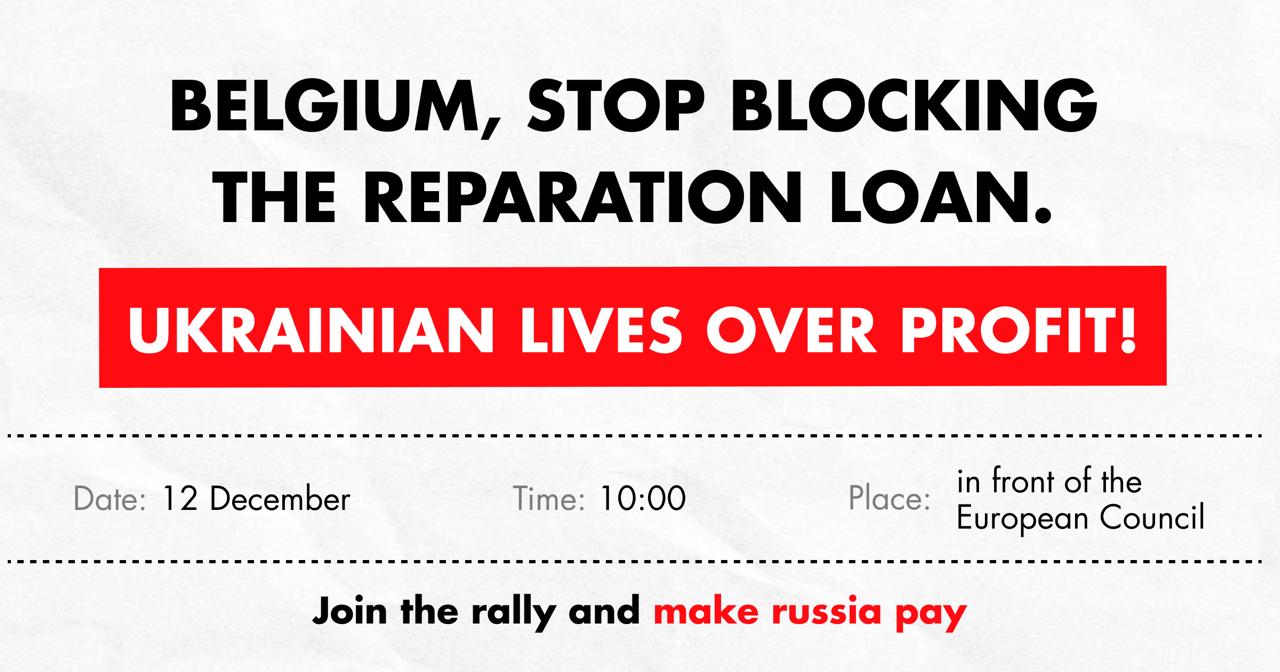
📣 Join the Demonstration!
Friday, December 12th
⏰ 10:00 AM
📍 Rue de la Loi 175
(in front of the EU Council)
BELGIUM, STOP BLOCKING THE REPARATION LOAN.
UKRAINIAN LIVES OVER PROFIT!
📰 For Journalists:
- Cover the concrete costs Belgium already pays (drones, disruptions, sabotage)
- Ask PM De Wever: "If all alternatives are blocked, what is your actual solution?"
- Interview legal experts on the tribunal victory probability
👥 For Citizens:
- Share the facts on social media
- Sign petitions supporting the Reparations Loan
- Contact your MPs and the Prime Minister's office
- Mobilise Civil Society Organisations
- December 12th demonstration — completed. See event details →
🏛️ For Policymakers:
- Cite historical precedents in parliamentary debates
- Request detailed cost-benefit analysis comparing action vs. inaction
- Build cross-party coalition for Belgian leadership
Belgium's Choice: Lead or Follow?
Prime Minister De Wever said Belgium holds "Europe's key financial leverage over the Kremlin."
The question is not whether Belgium will be affected by this decision.
Europe is already affected - Russian
drones fly over Belgian territory now.
The question is: Will Belgium use its leverage to shape European security, or surrender it through inaction?
In 1990, 2008, and 2014, Europe hesitated.
Each time, war broke out and the cost grew.
History is watching. Belgium can lead Europe to justice and security, or be remembered as the country that returned money to its aggressor.
The time to act is now. December 2025.